
[US] Importing wheels from Japan — what’s the real duty rate?
This article is about importing to the US. All duty rates are as of today; tariff policy changes fast, so confirm the current rate before you actually buy. Written about wheels, but the same structure applies to auto parts imported from Japan to the US generally (intakes, suspension, braces, etc.).
Even correctly classified, US duty is now 15% (not 2.5%). Get it misclassified and it can jump to ~50%. Simple conclusion — don't buy from anyone but DDP. If you must buy DDU, make the seller submit origin documents before customs clearance. That's the only way to prevent misclassification.
Reddit This article is a detailed rewrite of a post read about 25,000 times on r/Wheels, expanded with the questions and firsthand experiences that came up in the comments. Original post: r/Wheels →
01The trap
Google "aluminum wheel tariff to the US" and you get 2.5%. That is not the current number. As of today, the real duty on wheels imported from Japan to the US is 15%.
And 15% is the good case. Worse is when they aren't classified correctly. Here's a real example.
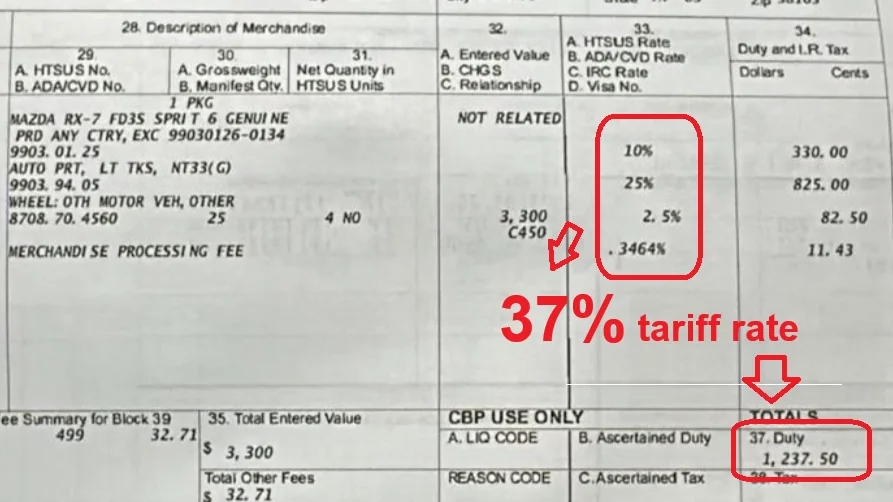
This is a real duty invoice for OEM Mazda RX-7 (FD3S) wheels I actually shipped to the US. Taxed 37%. The reason is simple: the wheels weren't correctly classified as "made in Japan."
And this isn't a warning about someone else. I've had a $945 bill hit a customer at the door because I shipped DDU. Sold for $2,800, $945.21 due at delivery. I refunded it all out of pocket. The full story — and what I turned my business into — is in the other article, "The $2,800 that became a $945 bill at the door." This article is the mechanism; that one is the true story.
02Why it happens
Carriers like FedEx classify shipments with an automated system. It assigns an HS code (the product classification code), and that sets the duty rate. Here's what happens, plainly:
The same single aluminum wheel can be taxed completely differently depending on what it's classified as.
- Correctly classified as an automotive aluminum wheel → 15%
- But calculated as plain aluminum material (raw stock) → can jump to ~50%
The thing you shipped is exactly the same wheel. What changed isn't the object — only the classification on paper. In other words, if you can't prove the classification, the system just defaults it to the higher bracket. That's what misclassification is. Japanese goods being treated as Chinese works the same way — if origin can't be proven, the rate spikes.
Then you're stuck correcting it through a dispute. And that correction takes time.
A reader gave an accurate point:
Right — HS code and country of origin are separate fields on paper (I learned that from this very comment). But in practice, the result — get any part of the classification wrong and the rate spikes — doesn't change. Real examples — and note these aren't limited to wheels:
"A $38 part got hit with duty equal to the part itself — 100%." (later found to be made in Turkey)
"Ordered a carbon intake from Blackhawk, taxed 50%. UPS had rewritten the HTS code to 'raw aluminum.' UPS admitted the mistake, but I'm still fighting for the refund."
"Ordered an aluminum fender brace from Japan and DHL first billed nearly 60%. I pushed back and got it to 30%, but a Regamaster I'd also ordered was quoted 50% and I cancelled it."
That carbon-intake case is exactly the "aluminum part treated as raw aluminum" I described. $38 taxed 100% is almost certainly a classification error too. Once it clears customs, reversing it becomes a nightmare. And this isn't wheel-specific — it happens across auto parts imported from Japan to the US.
03How to avoid it
① Base stance: don't buy from anyone but DDP.
This is the main thing. If the duty is billed to you (the buyer) — DDU — don't buy.
When you're billed, there's no guarantee the amount is right. What should be 15% can hit 50%, and reversing it becomes your job. The seller already has your money. They can ignore it and walk. That's the structure.
With DDP (Delivered Duty Paid), the price quoted is the price you pay. Any misclassification or overcharge is the seller's problem, not yours. Who the duty is billed to — this one point matters more than anything when you buy wheels from Japan.
② If you must buy DDU: make the seller submit origin documents before clearance.
Some countries and sellers can't do DDP. In that case, the only way to prevent misclassification is to have the seller submit proof of origin before the shipment clears customs. This doesn't apply if you buy DDP, but if you buy DDU it's a lifeline.
Concretely, what to submit so classification is less likely to go wrong:
- A photo of the "Made in Japan" stamp (the cast mark on the back of the wheel)
- The manufacturer's product label (brand name / model number)
- The serial number
- If you don't have the item, the maker's official catalog / product page — anything showing "a Japanese-made automotive wheel"
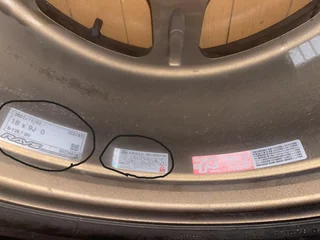
Submit these to FedEx before clearance and the odds of being correctly classified as "a Japanese-made automotive wheel" go way up. The problem is that small shops and individual sellers won't prepare these unless you specify it. Even big proxies don't go this far per shipment. So the buyer has to ask explicitly.
If explaining this to the seller is a hassle, you can just send them the link to this page. It's written so "please submit the documents listed here before clearance" is enough to get the point across.
③ If misclassification still happens: dispute + re-assessment with origin docs.
Even with prep, customs can misclassify. The steps then:
- The person billed the duty files the dispute.
- Submit the origin documents above (photos of the stamp / label / serial).
- This triggers a re-assessment.
A real case from one of my own shipments (AWB 8845••••1815, a set of TE37 XT). Personal details redacted.
Dear FedEx Customs Team,

We are contacting you regarding a shipment with the following tracking number:
FedEx Air Waybill: 8845••••1815

The recipient has received a very high customs charge, but neither the recipient
nor the shipper has received any detailed invoice showing how the duty and fees
were calculated.

Before proceeding with payment, we would like to understand which tariff
classification and duty rate were applied to this shipment.

We have experienced a similar issue in the past, where the system mistakenly
applied a China-origin (Section 301) tariff rate even though the product was
manufactured in Japan. We are concerned this may have happened again here.

Please note that this product is 100% made in Japan, and we can provide proof
of origin (invoice, manufacturer information, or photos) if required.

We would greatly appreciate it if you could review the case and confirm the
tariff code and duty rate that were used for this entry.

Thank you very much for your time and assistance.

Best regards,
Akinari Uchiyama
OPUS JDM
Email: stormforce@jdmexpo.jp
I did exactly this when my wheels were misclassified. Ten days after filing for re-assessment, it went back to the correct rate. Even without origin markings on the item, finding the maker's catalog or official page online and attaching it can lead to a refund. Even after it's cleared, it's worth trying before you give up.
04How OPUS does it
I calculate duty at quote time and include it in the price, and I set the shipper (me) as the party billed. You see one price and pay one price. FedEx won't come to the door for more. I also prepare the origin documents before clearance — since I started attaching the "Made in Japan" stamp and maker label every time, the correct rate applies consistently. Not putting the misclassification risk on the buyer — that's what shipping DDP means.
On whether this tariff is politically right or wrong — that's beyond me. All I can control is making sure you know the full total before you pay.
 Keep learning
The Import Playbook — the full guide
More real-money lessons on importing from Japan: market price, shipping, duties, and who to buy from.
Explore all the articles arrow_forward
Keep learning
The Import Playbook — the full guide
More real-money lessons on importing from Japan: market price, shipping, duties, and who to buy from.
Explore all the articles arrow_forward
Worried about duties, shipping, or anything else?
Ask me anything about this — I'll reply within 24 hours. No sales messages, ever.
We send it for you — no email app needed. Or email stormforce@jdmexpo.jp directly. Your page link is attached so I know which article you're reading.
Estimate your wheels' landed cost — duty included.
Enter the specs and you'll see the DDP total picture, with the 15% already in it.
travel_explore Search for wheels with the tool
"The HS code sets the 'product classification' and should be a separate field from country of origin. Road wheels would be 8708.70.45.xx. But the catch-all above it looks like it's eating a high rate. Did the box have multiple items in it?"